
The best thing about Pragamata is its perfect 30-second gameplay loop. In game development, “finding the fun” is always a conundrum. You can have the best visuals, the most meticulously crafted sound design for firing a gun, but if the player doesn’t like holding the controller for 30 seconds, loop after loop, it’s game over. In Pragmata, the player is never worn out. It asks you to use both the “gun and ball gamer” part of your brain and the logistical, problem-solving part. Just emptying your chamber into a robot is not a rewarding experience. Get ready to train those thumbs, because you’ll be solving puzzles in every fight, and you’ll love it.
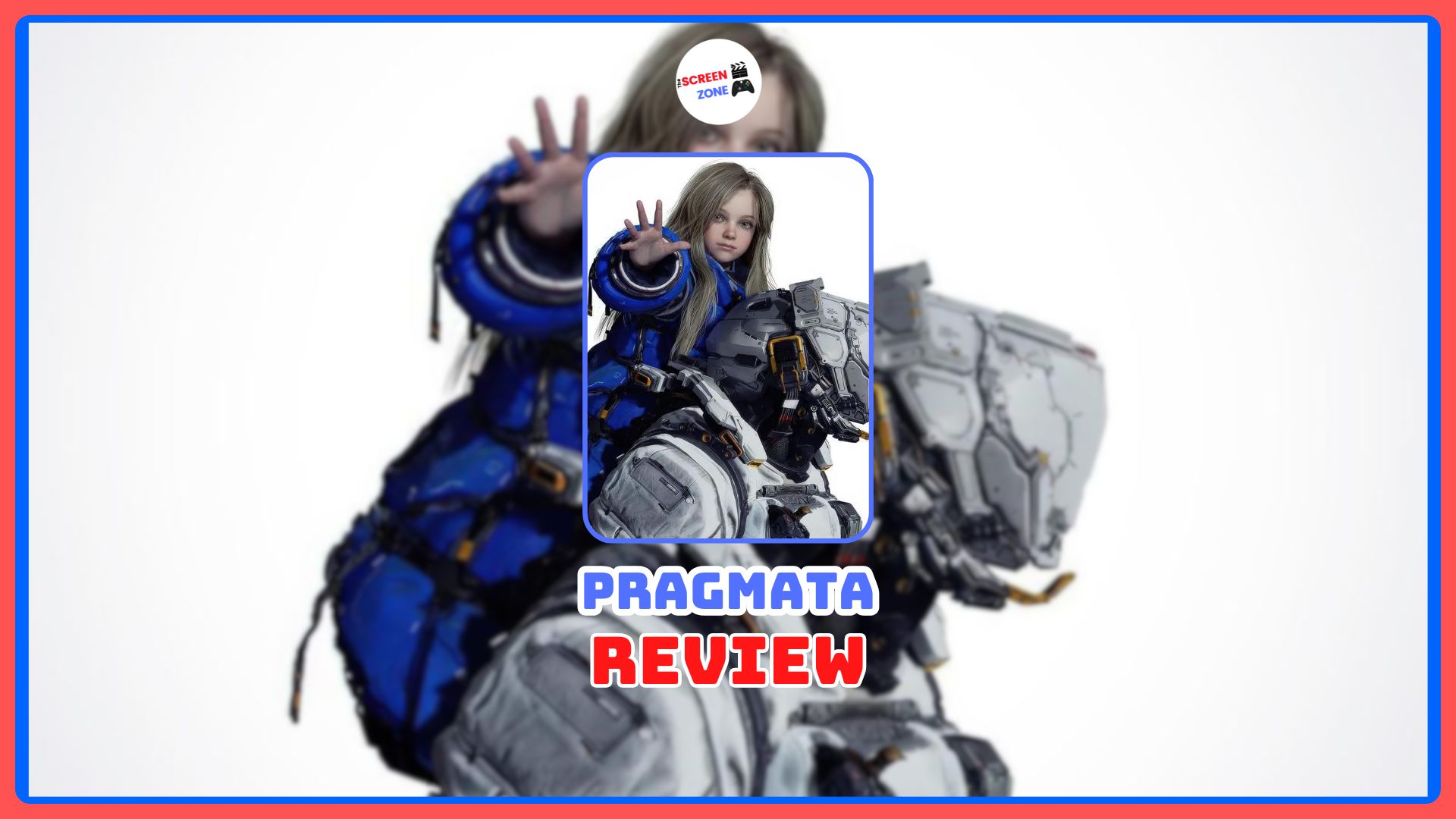
Pragmata follows space explorer Hugh on a desolate moon base, haunted by rogue automatons. To contact Earth and escape, he must work with a “Pragmata” - a humanoid robot created for testing. Of course, since this is a AAA video game, Hugh’s partner Pragmata is in the form of a little girl, dubbed “Diana”. She’s the cutest. Together, they must persevere through endless hordes of robots and engineering challenges to bring back all the systems of the “Cradle”, the moon base, online.
Hugh handles the shooting, and Diana handles the hacking. You, as the player, do both. As you encounter enemies, it’s in your best interest to direct your cursor through various hacking nodes to weaken them before taking the kill shot. And it works beautifully. Everything, from the UI to how fast the nodes move, to the controls and the sound design, makes every node jump satisfying. It’s distilling the fun of solving a Tetris block, or a Rubik’s cube, into just a handful of seconds. Because you need to take your time with it, movement becomes necessary. You’ll constantly be jumping, sprinting, and gliding across the air, keeping a safe distance from the enemy as you hack them. If you’re good enough to deal critical damage via specific nodes, you can close the distance for a very satisfying finisher.
Note: You can listen to my first impressions of Pragmata on the Day Zero podcast, with more expanded discussion in a later episode.
While a lot of games media’s focus on Pragmata has been on it building upon the usual found family relationship dynamics, there’s one aspect that I haven’t seen discussed enough. Pragmata, in the big 2026, is also about AI. Kind of. The game has been in development for over 5 years, so it’s not like it started its story ideas from the reality we all share today. It’s certainly commenting and examining more “rogue AI from Terminator” rather than generative AI tools that Google and OpenAI are propping up. However, where there’s AI automation, there is downsizing and corporate calculus. Pragmata doesn’t offer any insightful commentary on either, but that’s not a net negative.
Capcom has always been great at designing tight, linear spaces that offer plenty of replayability, combined with a slow but rewarding progression tree, and Pragmata delivers in spades. Each sector of the moon base is divided into varying levels, distinguished by different biomes. After each level, you’ll be visiting the Shelter, a central hub for respite. I don’t always love hub worlds, but Pragmata does it well. The initial upgrades and collectables seem uninteresting, offering a very clear and boring path to ultimate power. Capcom being Capcom, however, has a few tricks up its sleeves.
It’s not enough to just weaken enemies through damage nodes. You can also deploy separate nodes that freeze, burn, electrify, and confuse enemies, turning them on each other. These special nodes aren’t always on the same path as the green “finisher” node, so you need to deploy quick thinking to pass over them. The risk-reward factor isn’t challenging on the normal difficulty, so you can pick your poison. Health is limited, but checkpoints are aplenty.
Of course, the soul of Pragmata is the relationship between Hugh and Diana. Like other games before it (The Last of Us, BioShock Infinite), the relationship deepens through plenty of voluntary interactions that aren’t central to the story. Sure, the story has its stakes, but how much you care for Diana will come from how much you interact with her at the base. Play hide and seek with her, gift her printable souvenirs representing various aspects of Earth life. There is no mean dad to caring dad route here, which would’ve been boring.
Capcom also mixes up the gameplay with new and exciting factors, like changing the intensity of gravity in certain biomes, or taking out the sound when walking on the lunar surface. Platforming skills take priority in these missions, and Hugh’s boosters are delightfully limited in their capability. You’ll need to strategically pick your enemies while gliding between platforms. In fact, the movement mechanics have enough fun factor that Capcom provided a training simulation, not unlike the one in FFVII Rebirth, to practice your skills. And if you do, you gain plenty of rewards to level up your abilities.
Pragmata PC Performance
I played the game across two systems - my personal system with an AMD Ryzen 7 5700X3D and Nvidia RTX 5070, and on Nvidia’s GeForce Now cloud service, which is equipped with an RTX 4080.
The RE engine has always been ridiculously optimised, although it doesn’t fare well in larger environments, as evidenced by Dragon’s Dogma 2. Fortunately, Pragmata is quite the linear game, showing off the genius of Capcom’s level designers and the folks in charge of progression. A limited environment means the team can push systems harder, to make each environment look exactly as well-lit as they wish. Ray tracing is heavy, as it always is, and sometimes it doesn’t make the whole image better, but I like that it’s light enough for most people to benefit from it one way or the other.
On my personal PC with the RTX 5070, I could easily play the game over 100fps at 1440p. Adding frame generation to the mix, I could do the same at 4K, while using DLSS of course. Here are some numbers:
- 1440p, Ray tracing on, DLSS Balanced - 127fps
- 1440p, Ray tracing on, DLSS Frame gen - 190fps
- 1440p, Ray tracing on, FSR 3 Quality - 170fps
- 1440p, Ray tracing on, FSR 3 Balanced - 180fps
As for VRAM usage, at 1440p I saw the VRAM counter go up to 10.14 GB. At 4K, that would come close to 12GB. Unfortunately, that means players with 8GB GPUs will have a compromised experience. I don’t think the increased VRAM demand reflects quite as equally on the quality and variety of the textures used in the game.
Of course, playing the game on GeForce Now was an equally smooth experience, especially on a large TV. On the service, I could crank up all the settings and comfortably game at 4K 60fps. The Geforce Now app on the TV didn’t let me unlock the framerate for a 100+ fps experience, but I can excuse that. I did notice that in order to get a 60fps experience, I had to use frame generation and DLSS.
Verdict
Pragmata has a new, near-perfect combat system that always pushes past its narrative’s predictability, and coupled with its expert level design and progression, it’s enough for anyone to have a good time.
REVIEW COPY PROVIDED BY CAPCOM.
Pragmata is available on PC, PS5, Nintendo Switch 2 and Xbox Series X}S.
Pros
- Level design
- Combat loop
- Diana's interactions
- PC performance
Cons
- Predictable narrative