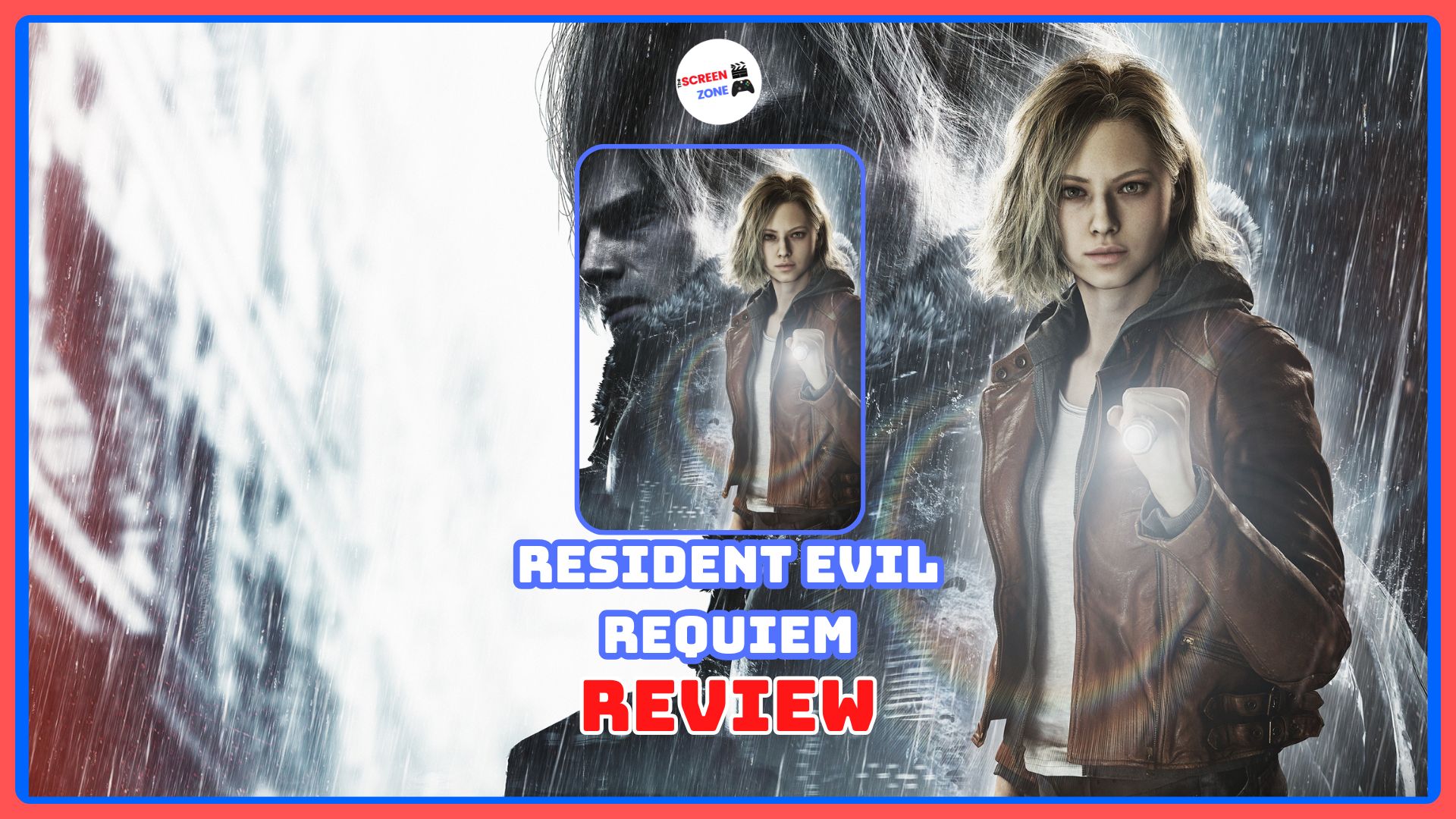

Resident Evil Requiem is, mostly, a slam dunk, combining the best of the franchise’s two styles from RE4 and RE7 to offer something familiar but comforting. Switching between nail-biting scares and heart-pumping thrill-ride action, Requiem offers an ode to Resident Evil’s evolution in its past, embracing fans old and new alike.
When RE7 changed the game’s perspective from third-person to first-person, it retained the franchise’s core focus on maintaining a spooky atmosphere while immersing players even more into it. Refocusing the tone by making the protagonist an everyman in Ethan Winters, which helps players project their own fears onto him. A compromise was made — Winters was relatable, but lacked edge. His fears and doubts needed to be rooted in a universality (“I must save my wife and daughter”), making him accessible but also generic. At the time, it felt like moving away from franchise mainstays like Chris Redfield and Leon Kennedy was necessary to breathe new life into it, and it was the right call.
Note: A brief overview of my impressions of the game can be found on the Day Zero podcast. The following review may contain minor spoilers.
Where do you go from there? With its ninth entry, Capcom decided to have it both ways. Grace Ashcroft, the initial protagonist of Requiem, has loose ties to the franchise’s past and is a fully formed character, but provides enough room for players to see themselves in her. Through her, Capcom manages to retain the fish-out-of-water energy in the narrative that powered the most recent sequels. On the other hand, Leon Kennedy makes his triumphant return, and boy, what a return! If Leon in RE2 was Steve Rogers pre-super-soldier serum, he in Requiem is Captain America throwing down with Thanos. Requiem features plenty of callbacks to Resident Evil 2, Leon’s inaugural adventure, making it closer to being a direct sequel to that game with Leon’s arc.
At the start of the game, it offers players the choice to switch between first and third-person camera perspectives. Capcom recommends players try out Grace’s sections in first-person, which, by design, are more tense, with their claustrophobia enhanced by the camera choice. For Leon, a third-person camera similar to RE4 is the preferred choice, but you can put yourself in his boots with the alternative choice. The camera choice is as much a step towards improved accessibility as it is a statement from Capcom — they are doubling down on the dual nature of the franchise’s styles, offering two distinct experiences in one combined narrative.
Where the game falters, perhaps, is in its pursuit of balancing both sides of the story. The narrative switches between Grace and Leon fairly frequently at the start, only to then dedicate hours on end to one character over the other. Grace gets one section for herself, taking a backseat afterwards for Leon’s one-man show. I like throwing hatchets and delivering roundhouse kicks to zombies as much as the next guy, but Requiem doesn’t strike the delicate balance between that power fantasy and survival horror the way RE4 did. It hurts to write this, but Requiem would’ve been a better experience had it dropped the dosage of Leon’s sections, making them sparse but more memorable. Don’t even get me started on one entire level that basks in the glory of painfully slow, scripted moments while giving absolutely no tools to fight back against your oppressors. It reminded me of Hellblade 2. Narratively cool stuff that loses its meaning when placed in a video game.

Every Resident Evil poses the same question: how do you make zombies exciting again? The undead make for fun canon fodder, but start blending together when not deployed in tense, controlled environments (see: the opening sections of RE2). Capcom has a simple yet effective solution: have them retain the last vestiges of their human memories. Combine that with a naturally dreadful location like an abandoned care clinic, and you’ve got gold. The Rhodes Chronic Care Center has already become an all-time favourite location in the franchise. It will take a long time before I forget its empty and dark hallways, having zombified chefs, nurses, and singers. Each enemy adheres to a specific behaviour, which can either be exploited or learned to avoid or execute.
Capcom also offers you the choice to dispose of them as either Grace or Leon. As Grace, ammo is scarce, meaning you’ll want to take a generally stealthy approach. You could take out the mini-bosses in one shot with the titular weapon, the all-powerful requiem revolver, but good luck trying to find all the lock picks scattered around the care centre to collect bullet-crafting materials. The requiem becomes a get-out-of-jail-with-heavy-fine card for Grace; a last resort should things get extra ugly.
Killing enemies feeds back into resource management with the blood collector. As Grace, you’re naturally running low on supplies of all sorts. The blood collector acts as currency to combine various supplies into useful ammo or healing items. Here’s a situation: I’m running low on health. Do I kill that enemy down the hall with bullets, which I also have just a handful of, and then collect its blood to craft a healing injector? Or do I craft a Hemolytic injector now, take out the enemy without wasting bullets, and collect enough blood from it to craft more bullets? It’s the stacking of similar micro-decisions that make every moment in Requiem worth the price of entry.
You’re doing all of this while, in some of the game’s most pulse-pounding sections, being chased by a deformed, monstrous giant who can’t wait to chomp on your head. Resident Evil has some iconic stalker enemies. Mr. X, Nemesis, Jack Baker, Lady Dimitrescu, and now, the Girl. Bravo Capcom. Thank you for locking me with her in a painfully dark basement. Truly a memorable experience. Will haunt me in my nightmares for a while to come.
If you’re smart enough to complete puzzles while being a pacifist, the reward becomes kicking those zombies’ asses with shotguns galore as Leon in the following section. Sadly, this flip-flopping nature of the gameplay loop is only restricted to that one section in the game, and that’s the most fun I had with it.
Perhaps the most surprising part of the game is when Capcom almost fooled me into believing it had pivoted Resident Evil into the open-world genre in its second act. Entering Raccoon City, Requiem offers one of the franchise’s largest open environments, fully explorable without any loading screens, filled with secrets, collectables, puzzles, bosses, and a lot of spectacle. There are elements here that a more pessimistic player might term as nostalgia bait. But nostalgia bait can be a gleeful tool when used right, which Requiem does.
As for its story, Requiem offers a somewhat satisfying, if not overly thrilling, narrative. Like many RE games, the bigger plot reveals all wait for their reveal until the third act. Most of it acts as a coda to the actions of the franchise’s most important players, while the inclusion of some new characters isn’t fleshed out enough to be narratively satisfying.
Resident Evil Requiem PC Performance
I played Requiem on a PC equipped with an AMD Ryzen 7 5700X3D, 32GB DDR4 RAM, and switched between two graphics cards. On the high-end NVIDIA GeForce RTX 5070 Ti, the game ran flawlessly at 1440p on the max preset, even before turning on path tracing or frame generation. With path tracing enabled, using DLSS becomes a minimum requirement. At 1440p output resolution with path tracing turned on, and DLSS on the performance mode, I got frame rates hovering around 150fps. Even with DLAA on the same settings, I was easily cruising above 75fps in intense areas like Raccoon City.
Frame generation vastly improves the experience. With path tracing and DLAA, combined with frame generation factors of 2X, 3X, and 4X, I got frame rates in the 128fps-300fps range. If you want to alleviate your VRAM load, turning down DLSS to performance mode can get you frame rates suited for a competitive high refresh rate monitor. However, frame generation will add input latency, so I suggest sticking with a suitable DLSS input factor based on your output resolution.
On PC, Requiem will most likely max out your GPU’s VRAM capacity before you get a chance to turn up any dials in the settings menu. The budget-focused, and older, RTX 3060 Ti only has 8GB to play with, and that was the biggest bottleneck in the overall experience. Using “Normal” textures with a mix of high and medium settings would blow past the 8GB buffer in intense scenes. Even on the 5070 Ti, VRAM usage can spike upwards of 15GB using the “High” texture assets and path tracing.
Fortunately, the game’s launch-day patch improved performance by what I perceived to be a significant margin. On the 3060 Ti, playing with path tracing at 60fps is possible, but only if you’re using DLSS performance mode, outputting at 1440p. You might have to settle for the “Low” texture quality, though, but the overall experience gets better when the output resolution is 1080p. With ray tracing set to the “high” setting and DLSS on the quality mode, I could run the game at 76fps.
Those without NVIDIA’s latest and greatest don’t need to worry, as FSR 3.1 frame generation is also available in the game. You can combine it with upscaling technologies like DLSS and FSR to get a decent experience even on lower-end hardware. How low? Well, that’s where the Steam Deck comes in.
On my Steam Deck OLED, Resident Evil Requiem can be easily run at around 45fps without frame generation. If you’re feeling adventurous, locking the internal frame rate to 30fps at higher settings and using FSR frame generation to double it to 60fps is a viable option. Just be prepared to deal with the added input lag and generally weird control feel, along with the animation artefacts.
Verdict
Resident Evil Requiem sits on the upper echelon of the franchise, offering a thrill ride that will delight fans both old and new.
REVIEW COPY PROVIDED BY CAPCOM.
Resident Evil Requiem is available on PC, PlayStation 5, Xbox Series X|S and Nintendo Switch 2.
Pros
- Tense atmosphere
- Expert level design
- Well-balanced puzzles
- Leon/Grace controls feel significantly different
Cons
- Lacklustre Narrative
- Leon overshadows Grace